
Buying a Home with an Attached Deck in Pelham? What a Local Inspector Looks At First
By Patrick S Dean · November 26, 2026 · 5 min read
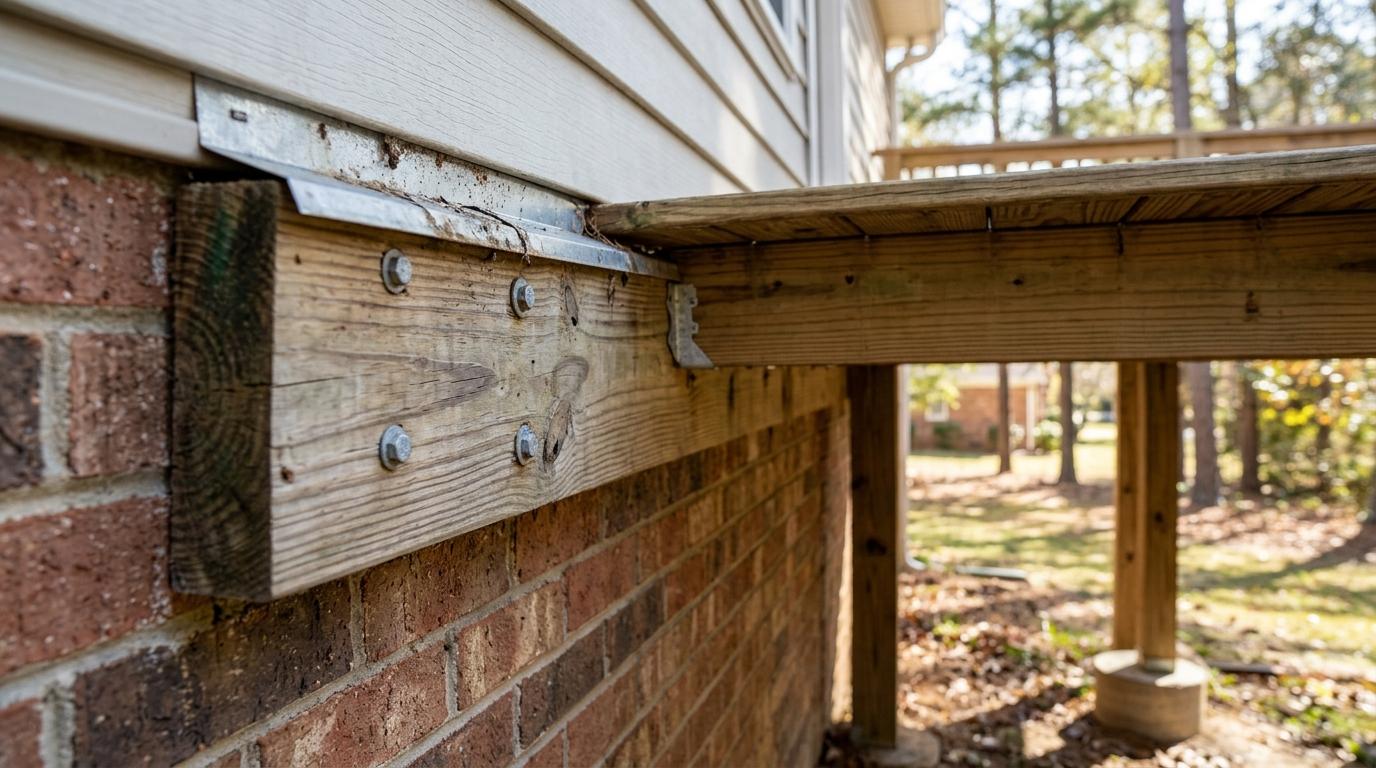
A few years back, a buyer in Helena called me after closing on a home with a big, beautiful attached deck off the back of the house. It looked great at the walkthrough. Eight months later, after a wet spring, they noticed the rim joist behind the siding was soft. The deck had been attached directly to the house with no proper flashing, and water had been quietly working its way into the framing for years.
That's the thing about attached decks in our part of Alabama. They're everywhere — off the back of 1990s two-stories in Pelham, on hillside homes in Vestavia Hills, on newer builds out in Chelsea. And because they're attached to the house, problems with them aren't just a deck problem. They can become a structural and moisture problem for the home itself.
If you're buying a home in Shelby or Jefferson County with an attached deck, here's what I look at, and what you should be thinking about too.
How the Deck Attaches to the House
This is the first thing I check on any attached deck, and it's where the most serious issues tend to live.
The deck should be connected to the home's framing through a ledger board that's properly fastened and — critically — properly flashed. Flashing is the metal detailing that keeps water from getting behind the ledger and into the rim joist and interior framing.
Common problems I see around here:
- Missing or inadequate flashing above the ledger board, which lets rain run straight into the wall assembly
- Ledger boards fastened with the wrong hardware — nails or undersized lag screws instead of the correct structural fasteners
- Decks bolted through siding or brick veneer without the proper standoffs or spacers, trapping moisture
- No gap between the ledger and the house, so water can't drain
On a brick home — very common in Mountain Brook, Homewood, and older Hoover neighborhoods — a deck attached directly through the brick veneer is a red flag. The brick isn't structural, and the attachment needs to reach the actual framing behind it.
If the attachment is done wrong, you're not just looking at a wobbly deck. You can be looking at rot in the band joist and framing of the house, which is a much bigger repair.
Footings, Posts, and Our Clay Soil
Our soil here matters. Much of Shelby and Jefferson County sits on expansive clay that swells when it's wet and shrinks when it's dry. That movement is hard on deck footings, and I see the results regularly.
What I'm looking for:
- Footings that are undersized or too shallow for our frost and soil conditions
- Posts that are set directly in dirt or concrete with no isolation, so they wick up moisture and rot from the bottom
- Posts that have shifted, tilted, or settled as the clay has moved season to season
- Improperly notched or spliced posts that weaken the load path
A deck on a hillside lot in Vestavia Hills or a sloped backyard in Chelsea often has taller posts and more complex bracing, which means more places for things to go wrong. I check post-to-beam and beam-to-joist connections closely, along with whether the deck has adequate lateral bracing to keep it from pulling away from the house over time.
A deck that feels solid underfoot during a quick showing can still have footings that are slowly failing. That's not something you can judge from a walkthrough.
Railings, Stairs, and the Safety Details
Railing and stair issues are some of the most common things I find on attached decks, and they're also among the most important for safety — especially in homes with kids or grandkids.
Things I look at:
- Railing height and post spacing — a railing that's too low or has posts spaced too far apart may not do its job
- Baluster spacing — gaps wide enough for a small child to slip through are a real hazard
- Whether the railing is attached to something solid — many railings are simply toenailed into the deck surface and will give way under a real load
- Stair treads, risers, and handrails — uneven treads, missing handrails, and open risers show up often
- Graspable handrails on stairs that actually meet the intent of the code, not just decorative rails
I also check the deck boards themselves — soft spots, rot at the ends, popped fasteners, and boards that have cupped or split from our summer heat and humidity. A deck that was built 15 years ago with untreated or under-treated lumber may look fine on the surface and be much softer underneath.
One more thing: if the deck is elevated, I look at what's underneath it. A deck that's been used as a covered storage area, with soil piled against the house or blocking ventilation, can contribute to moisture problems in a crawlspace or basement.
When I Want a Closer Look
Some decks need more than a visual walk-around, and that's where the tools matter.
On elevated decks with limited clearance underneath, I can use a limited-clearance crawl capability to get eyes on the framing, joists, and connections that you simply can't see from standing on top. On tall or steep-lot decks — common in the hilly parts of Hoover and Vestavia Hills — drone imaging can help me document roof-to-deck transitions and hard-to-reach areas safely.
If the home has a septic system or the deck is near a sanitary lateral, a sanitary lateral video scope can also help confirm the condition of underground lines that a standard visual inspection can't reach. And on any home, thermal imaging can help me spot moisture and temperature anomalies behind walls and around the ledger area that may not be visible to the naked eye.
I want to be clear about scope: a home inspection is visual and limited. I can identify conditions, recommend further evaluation, and point out things that need attention — but I can't see inside every wall or predict exactly when a footing will fail. What I can do is give you a clear, honest picture of what's visible and what it might mean.
If a deck issue looks like it involves structural framing, engineering, or a code question, I'll tell you to bring in a licensed structural engineer or the appropriate qualified professional. That's part of doing the job right.
Before You Close on That Pelham-Area Home
An attached deck is one of those features that can add real enjoyment to a home — and one of the most common places I find deferred maintenance, DIY shortcuts, and hidden moisture damage.
If you're buying in Pelham, Helena, Chelsea, Hoover, Homewood, Mountain Brook, Vestavia Hills, or anywhere across Shelby and Jefferson County, a careful look at the deck is worth the time. It's also worth it if you already own your home and haven't had the deck looked at in a while.
At HomeScan Home Inspection Services LLC, I bring years of construction and contracting background to every inspection, and I'll walk you through what I find in plain language — no jargon, no scare tactics. If you have questions about a deck, a crawlspace, or anything else on a home you're considering, I'm happy to talk it through with you.
You can reach out to schedule an inspection or just ask a question. There's no pressure — I'd rather you make a confident, informed decision than a quick one.